Watson ââåabstract Painting in Americaã¢ââ Magazine of Art

Lyrical brainchild is either of two related but singled-out trends in Post-war Modernist painting:
European Abstraction Lyrique born in Paris, the French art critic Jean José Marchand beingness credited with coining its name in 1947, considered equally a component of Tachisme when the name of this movement was coined in 1951 by Pierre Guéguen and Charles Estienne the author of L'Art à Paris 1945–1966, and American Lyrical Abstraction a movement described by Larry Aldrich (the founder of the Aldrich Contemporary Art Museum, Ridgefield Connecticut) in 1969.[2] [three]
A third definition is the usage as a descriptive term. Information technology is a descriptive term characterizing a blazon of abstract painting related to Abstract Expressionism; in use since the 1940s. Many well known abstract expressionist painters such as Arshile Gorky seen in context accept been characterized every bit doing a type of painting described as lyrical abstraction.[4] [v] [6]
Origin [edit]
The original common use refers to the tendency attributed to paintings in Europe during the mail-1945 menses and as a way of describing several artists (mostly in France) with painters like Wols, Gérard Schneider and Hans Hartung from Frg or Georges Mathieu, etc., whose works related to characteristics of gimmicky American abstract expressionism. At the fourth dimension (late 1940s), Paul Jenkins, Norman Bluhm, Sam Francis, Jules Olitski, Joan Mitchell, Ellsworth Kelly, and numerous other American artists were, as well, living and working in Paris and other European cities. With the exception of Kelly, all of those artists developed their versions of painterly abstraction that has been characterized at times as lyrical abstraction, tachisme, color field, Nuagisme and abstract expressionism.
The art move Brainchild lyrique was born in Paris after the war. At that fourth dimension, the artistic life in Paris, which had been devastated past the Occupation and Collaboration, resumed with numerous artists exhibited again every bit soon as the Liberation of Paris in mid-1944. According to the new abstraction forms that characterised some artists, the movement was named by the art critic, Jean José Marchand, and the painter, Georges Mathieu, in 1947. Some art critics besides looked at this movement as an attempt to restore the image of artistic Paris, which had held the rank of capital of the arts until the state of war. Lyrical abstraction also represented a competition between the School of Paris and the new New York School of Abstract Expressionism painting represented above all since 1946 past Jackson Pollock, then Willem de Kooning or Mark Rothko, which were also promoted by the American authorities from the early on 1950s.
Lyrical abstraction was opposed not simply to the Cubist and Surrealist movements that preceded it, merely as well to geometric abstraction (or "common cold abstraction"). Lyrical abstraction was, in some means, the first to apply the lessons of Wassily Kandinsky, considered 1 of the fathers of abstraction. For the artists, lyrical abstraction represented an opening to personal expression.
Finally, in the tardily 1960s (partially equally a response to minimal art, and the dogmatic interpretations by some to Greenbergian and Juddian formalism), many painters re-introduced painterly options into their works and the Whitney Museum and several other museums and institutions at the time formally named and identified the movement and uncompromising render to painterly brainchild as 'lyrical brainchild'.
European abstraction lyrique [edit]
Just afterwards Earth War 2, many artists quondam and young were back in Paris where they worked and exhibited: Nicolas de Staël, Serge Poliakoff, André Lanskoy and Zaks from Russia; Hans Hartung and Wols from Germany; Árpád Szenes, Endre Rozsda and Simon Hantaï from Hungary; Alexandre Istrati from Romania; Jean-Paul Riopelle from Canada; Vieira da Silva from Portugal; Gérard Ernest Schneider from Switzerland; Feito from Spain; Bram van Velde from the Netherlands; Albert Bitran from Turkey; Zao Wou-Ki from China; Sugai from Nihon; Sam Francis, John Franklin Koenig, Jack Youngerman and Paul Jenkins from the United statesA.
All these artists and many others were at that time amid the "Lyrical Abstractionists" with the French: Pierre Soulages, Jean-Michel Coulon, Jean René Bazaine, Jean Le Moal, Gustave Singier, Alfred Manessier, Roger Bissière, Pierre Tal-Glaze, Jean Messagier, Jean Miotte, and others.
Lyrical Abstraction was opposed not only to "fifty'Ecole de Paris" remains of pre-state of war style but to Cubist and Surrealist movements that had preceded information technology, and also to geometric abstraction (or "Cold Brainchild"). For the artists in France, Lyrical Abstraction represented an opening to personal expression. In Kingdom of belgium, Louis Van Lint figured a remarkable example of an artist who, after a short flow of geometric abstraction, has moved to a lyrical abstraction in which he excelled.
Many exhibitions were held in Paris for example in the galleries Arnaud, Drouin, Jeanne Bucher, Louis Carré, Galerie de France, and every year at the "Salon des Réalités Nouvelles" and "Salon de Mai" where the paintings of all these artists could be seen. At the Drouin gallery one could see Jean Le Moal, Gustave Singier, Alfred Manessier, Roger Bissière, Wols and others. A wind blew over the capital when Georges Mathieu decided to agree two exhibitions: L'Imaginaire in 1947 at the Palais du Luxembourg which he would have prefer to call abstraction lyrique to impose the proper name and and then HWPSMTB with (Hans Hartung, Wols, Francis Picabia, François Stahly sculptor, Georges Mathieu, Michel Tapié, and Camille Bryen) in 1948.
In March 1951 was held the larger exhibition Véhémences confrontées in the gallery Nina Dausset where for the first time were presented side to side French and American abstract artists. Information technology was organised by the critic Michel Tapié, whose role in the defense force of this movement was of the highest importance. With these events, he déclared that « the lyrical brainchild is born ».
It was, withal, a fairly short reign (tardily 1957), which was rapidly supplanted by the New Realism of Pierre Restany and Yves Klein.
Starting around 1970, this move has been revived by a new generation of artists built-in during or immediately after the Second World War. Some of its key promoters include Paul Kallos, Georges Romathier, Michelle Desterac, and Thibaut de Reimpré.
An exhibition entitled "The Lyrical Flight, Paris 1945–1956" (L'Envolée Lyrique, Paris 1945–1956), bringing together the works of lx painters, was presented in Paris at the Musée du Luxembourg from April to Baronial 2006 and included the most prominent painters of the movement: Georges Mathieu, Pierre Soulages, Gérard Schneider, Zao Wou-Ki, Albert Bitran, Serge Poliakoff.[7]
Artists in Paris (1945–1956) and beyond [edit]
The states [edit]

Ronnie Landfield, For William Blake 1968, a/c, 110 x 256 inches, exhibited: Belfry 49, NYC, January 3, 2002–November fifteen, 2002.[13] His work was included in the Lyrical Abstraction exhibitions at the Whitney Museum in 1970, the Sheldon Museum in 1993 and at the Boca Raton Museum in 2009.
American Lyrical Abstraction is an art movement[14] that emerged in New York City, Los Angeles, Washington, DC, and and so Toronto and London during the 1960s–1970s. Characterized by intuitive and loose paint handling, spontaneous expression, illusionist space, acrylic staining, process, occasional imagery, and other painterly and newer technological techniques.[15] Lyrical Abstraction led the way abroad from minimalism in painting and toward a new freer expressionism.[16] Painters who direct reacted against the predominating Formalist, Minimalist, and Pop Fine art and geometric abstraction styles of the 1960s, turned to new, experimental, loose, painterly, expressive, pictorial and abstract painting styles. Many of them had been Minimalists, working with diverse monochromatic, geometric styles, and whose paintings publicly evolved into new abstract painterly motifs. American Lyrical Abstraction is related in spirit to Abstract Expressionism, Color Field painting and European Tachisme of the 1940s and 1950s as well. Tachisme refers to the French style of abstract painting current in the 1945–1960 period. Very shut to Fine art Informel, information technology presents the European equivalent to Abstract Expressionism.
The Sheldon Museum of Art held an exhibition from 1 June until 29 August 1993 entitled Lyrical Abstraction: Color and Mood. Some of the participants included Dan Christensen, Walter Darby Bannard, Ronald Davis, Helen Frankenthaler, Sam Francis, Cleve Gray, Ronnie Landfield, Morris Louis, Jules Olitski, Robert Natkin, William Pettet, Mark Rothko, Lawrence Stafford, Peter Immature and several other painters. At the time the museum issued a statement the read in part:
"As a motility, Lyrical Abstraction extended the post-war Modernist aesthetic and provided a new dimension within the abstract tradition which was clearly indebted to Jackson Pollock's "dripped painting" and Mark Rothko'south stained, color forms. This motility was born out of a desire to create a direct physical and sensory feel of painting through their monumentality and emphasis on color – forcing the viewer to "read" paintings literally equally things."[17]
During 2009 the Boca Raton Museum of Art in Florida hosted an exhibition entitled Expanding Boundaries: Lyrical Abstraction Selections from the Permanent Collection
At the time the museum issued a argument that said in role:
"Lyrical Abstraction arose in the 1960s and 70s, post-obit the claiming of Minimalism and Conceptual art. Many artists began moving away from geometric, difficult-edge, and minimal styles, toward more lyrical, sensuous, romantic abstractions worked in a loose gestural way. These "lyrical abstractionists" sought to expand the boundaries of abstract painting, and to revive and reinvigorate a painterly 'tradition' in American art. At the same time, these artists sought to reinstate the primacy of line and color as formal elements in works equanimous according to aesthetic principles – rather than as the visual representation of sociopolitical realities or philosophical theories."
"Characterized by intuitive and loose pigment handling, spontaneous expression, illusionist infinite, acrylic staining, process, occasional imagery, and other painterly techniques, the abstruse works included in this exhibition sing with rich fluid color and quiet free energy. Works by the post-obit artists associated with Lyrical Abstraction will exist included: Natvar Bhavsar, Stanley Boxer, Lamar Briggs, Dan Christensen, David Diao, Friedel Dzubas, Sam Francis, Dorothy Gillespie, Cleve Gray, Paul Jenkins, Ronnie Landfield, Pat Lipsky, Joan Mitchell, Robert Natkin, Jules Olitski, Larry Poons, Garry Rich, John Seery, Jeff Way and Larry Zox."[eleven]
History of the term in America [edit]
Lyrical Brainchild, an exhibition in the Whitney Museum of American Art, May 25–July 6, 1971 was described by John I. H. Baur, curator of the Whitney Museum of American Fine art:[18]
- "To be given an entire exhibition surveying a electric current trend in American art at a unmarried blow is an experience unusual to the verge of the bizarre ... Mr. Aldrich defines the trend of Lyrical Brainchild and explains how he came to acquire the works ..."
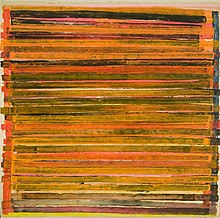
Lyrical Abstraction was the championship of a circulating exhibition which commenced at the Aldrich Contemporary Art Museum, Ridgefield, Connecticut from April 5 through June 7, 1970,[19] and ended at the Whitney Museum of American Art, New York, May 25 through July vi, 1971.[20] Lyrical Abstraction is a term that was used past Larry Aldrich (the founder of the Aldrich Contemporary Art Museum, Ridgefield Connecticut) in 1969 to describe what Aldrich said he saw in the studios of many artists at that time.[2] [21] Mr. Aldrich, a successful designer and art collector, divers the trend of Lyrical Abstraction and explained how he came to acquire the works.[22] In his "Statement of the Exhibition" he wrote,
Early final season, information technology became credible that in painting there was a movement away from the geometric, hard-edge, and minimal, toward more than lyrical, sensuous, romantic abstractions in colors which were softer and more vibrant ... The artist's touch is always visible in this type of painting, fifty-fifty when the paintings are washed with spray guns, sponges or other objects ... As I researched this lyrical trend, I plant many young artists whose paintings appealed to me so much that I was impelled to acquire many of them. The majority of the paintings in the Lyrical Brainchild exhibition were created in 1969 and all are a part of my collection now.
Larry Aldrich donated the paintings from the exhibition to the Whitney Museum of American Fine art.[23]
For many years the term Lyrical Abstraction was a debasing, which unfortunately adversely affected those artists whose works were associated with that name. In 1989 Union College art history professor, the late Daniel Robbins observed that Lyrical Brainchild was the term used in the late sixties to describe the render to painterly expressivity by painters all over the country and "consequently", Robbins said, "the term should be used today because it has historical credibility"[24]
Exhibition participants [edit]
The following artists participated in the exhibition Lyrical Abstraction.[25] [26]
Relation to other tendencies [edit]
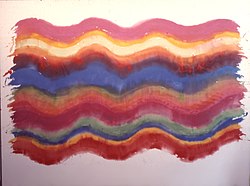
Pat Lipsky, Spiked Scarlet, 1970. Her work was included in the Lyrical Abstraction exhibition at the Whitney Museum in 1970 and at the Boca Raton Museum in 2009.
Lyrical Abstraction forth with the Fluxus move and Postminimalism (a term first coined past Robert Pincus-Witten in the pages of Artforum in 1969)[34] sought to aggrandize the boundaries of abstract painting and Minimalism by focusing on procedure, new materials and new ways of expression. Postminimalism ofttimes incorporating industrial materials, raw materials, fabrications, found objects, installation, series repetition, and often with references to Dada and Surrealism is best exemplified in the sculptures of Eva Hesse.[34] Lyrical Brainchild, Conceptual Art, Postminimalism, Earth Art, Video, Performance art, Installation art, along with the continuation of Fluxus, Abstruse Expressionism, Colour Field Painting, Hard-border painting, Minimal Art, Op art, Popular Art, Photorealism and New Realism extended the boundaries of Contemporary Art in the mid-1960s through the 1970s.[35] Lyrical Abstraction is a blazon of freewheeling abstract painting that emerged in the mid-1960s when abstract painters returned to various forms of painterly, pictorial, expressionism with a predominate focus on process, gestalt and repetitive compositional strategies in full general. Characterized past an overall gestalt, consequent surface tension, sometimes even the hiding of brushstrokes, and an overt avoidance of relational composition. It developed equally did Postminimalism as an alternative to strict Formalist and Minimalist doctrine.
Lyrical Abstraction shares similarities with Color Field Painting and Abstruse Expressionism especially in the freewheeling usage of paint – texture and surface, an case is illustrated by the painting by Ronnie Landfield entitled For William Blake. Direct cartoon, calligraphic use of line, the effects of brushed, splattered, stained, squeegeed, poured, and splashed paint superficially resemble the effects seen in Abstruse Expressionism and Color Field Painting. However the styles are markedly dissimilar. Setting it apart from Abstruse Expressionism and Action Painting of the 1940s and 1950s is the approach to limerick and drama. As seen in Action Painting there is an emphasis on brushstrokes, high compositional drama, dynamic compositional tension. While in Lyrical Abstraction at that place is a sense of compositional randomness, all over composition, depression key and relaxed compositional drama and an emphasis on procedure, repetition, and an all over sensibility. The differences with Color Field Painting are more subtle today because many of the Colour Field painters similar Helen Frankenthaler, Jules Olitski, Sam Francis, and Jack Bush[36] with the exceptions of Morris Louis, Ellsworth Kelly, Paul Feeley, Thomas Downing, and Gene Davis evolved into Lyrical Abstractionists. Lyrical Abstraction shares with both Abstract Expressionism and Color Field Painting a sense of spontaneous and immediate sensual expression, consequently distinctions betwixt specific artists and their styles become blurred, and seemingly interchangeable as they evolve.
By the mid-1950s, Richard Diebenkorn abandoned abstract expressionism and along with David Park, Elmer Bischoff and several others formed the Bay Area Figurative School with a return to Figurative painting. During the period between the fall 1964 and the bound of 1965 Diebenkorn traveled throughout Europe, he was granted a cultural visa to visit and view Henri Matisse paintings in of import Soviet museums. He traveled to the then Soviet Union to study Henri Matisse paintings in Russian museums that were rarely seen outside of Russia. When he returned to painting in the Bay Area in mid-1965 his resulting works summed upwardly all that he had learned from his more a decade as a leading figurative painter.[37] When in 1967 he returned to abstraction his works were parallel to movements similar the Colour Field move and Lyrical Abstraction.[38]
In the 1960s, English painter John Hoyland'southward Colour field paintings were characterised past uncomplicated rectangular shapes, loftier-primal colour and a flat picture surface. In the 1970s his paintings became more textured.[39] During the 1960s and 1970s, he showed his paintings in New York Urban center with the Robert Elkon Gallery and the André Emmerich Gallery. His paintings were closely aligned with Post-Painterly Abstraction, Color Field painting and Lyrical Abstraction.[28]
Abstract Expressionism preceded Color Field painting, Lyrical Abstraction, Fluxus, Popular Art, Minimalism, Postminimalism, and the other movements of the 1960s and 1970s and it influenced the later movements that evolved. The interrelationship of/and betwixt distinct but related styles resulted in influence that worked both ways between artists young and one-time, and vice versa. During the mid-1960s in New York, Los Angeles and elsewhere artists often crossed the lines between definitions and fine art styles. During that period – the mid-1960s through the 1970s advanced American fine art and contemporary art in general was at a crossroad, shattering in several directions. During the 1970s political movements and revolutionary changes in communication fabricated these American styles international; equally the fine art earth itself became more than and more international. American Lyrical Abstraction'south European counterpart Neo-expressionism came to boss the 1980s, and besides developed equally a response to American Pop Art and Minimalism and borrows heavily from American Abstract Expressionism.
Painters in America [edit]
This is a list of artists, whose work or a period or meaning aspects of it, has been seen as lyrical brainchild, including those earlier the identification of the term or tendency in America in the 1960s.
See also [edit]
- Abstract expressionism
- Colour field painting
- Hard-edge painting
- Post-painterly abstraction
- Tachisme
- COBRA (avant-garde movement)
- Formalism (fine art)
- Western painting
- History of painting
- Orphism (art)
- Nuagisme
References [edit]
- ^ Tate Drove - John Hoyland
- ^ a b Aldrich, Larry. Young Lyrical Painters, Art in America, v.57, n6, November–December 1969, pp.104–113.
- ^ [1] Thomas B. Hess on Larry Aldrich, Retrieved June 10, 2010
- ^ Arshile Gorky a Retrospective at the Tate Mod
- ^ Kemper Museum Retrieved June five, 2010
- ^ interview with Richard Bellamy, 1963, Archives of American Fine art, retrieved February 1st, 2009
- ^ The Lyrical Flight, Paris 1945–1956, texts Patrick-Gilles Persin, Michel and Pierre Descargues Ragon, Musée du Luxembourg, Paris and Skira, Milan, 2006, 280 p. ISBN 88-7624-679-7.
- ^ The Archives of American Art, Smithsonian, Betty Parsons Gallery Papers, Reel 4087–4089: Exhibition Records, Reel 4108: Artists Files, final names A–B.
- ^ Flight lyric, Paris 1945–1956, texts Patrick-Gilles Persin, Michel and Pierre Descargues Ragon, Musée du Luxembourg, Paris and Skira, Milan, 2006, 280 p. ISBN 88-7624-679-7.
- ^ a b artnet retrieved May 24, 2010
- ^ a b c d e f g h i j one thousand l grand n o p q r s Expanding Boundaries: Lyrical Abstraction: Selections from the Permanent Collection, Boca Raton Museum of Fine art, retrieved June 17, 2009
- ^ NY Mag, Sept. xi, 1972, Vol. 5, #37
- ^ 2002 Exhibition review, retrieved October 27, 2008 Archived July 9, 2012, at archive.today
- ^ Lyrical Abstraction: Colour and Mood, Sheldon Museum of Art, exhibition review "New Exhibit goes big, bold" Lincoln Periodical-Star, Sunday, May 30th, 1993
- ^ Ashton, Dore. Young Abstruse Painters: Right On! Arts v. 44, n. iv, February, 1970, pp. 31–35.
- ^ Ratcliff, Carter. The New Informalists, Art News, 5. 68, due north. eight, Dec 1969, p.72.
- ^ University of Nebraska Lincoln, Sheldon Museum of Art, May 1993
- ^ Lyrical Abstraction, exhibition: May 25 through July 6, 1971, "Foreword past John I. H. Baur"
- ^ Lyrical Abstraction, exhibition: April 5 through June seven, 1970.
- ^ Lyrical Abstraction, exhibition: May 25 through July six, 1971.
- ^ "Interview with John Seery 2010, Whitewall Mag". Archived from the original on 2012-03-01. Retrieved 2010-05-26 .
- ^ Lyrical Abstraction, exhibition: Apr 5 through June 7, 1970. Argument of the exhibition"
- ^ Lyrical Abstraction , exhibition: May 25 through July half-dozen, 1971, "Foreword by John I. H. Baur"
- ^ Robbins, Daniel. Larry Poons: Creation of the Circuitous Surface, Exhibition Catalogue, Salander/O'Reilly Galleries, p. 10, 1990.
- ^ Lyrical abstraction Aldrich Museum of Contemporary Art, 1970
- ^ Lyrical Brainchild Gift of the Larry Aldrich Foundation, 1971
- ^ a b c d eastward f Saatchi Retrieved May 27, 2010
- ^ a b c d e f g h [two] Archived 2010-07-03 at the Wayback Machine Santa Barbara Museum, retrieved June 2, 2010
- ^ a b c d Inc, Time (1970-05-01). "LIFE".
- ^ NY Magazine, 1969
- ^ David Bourdon, Life Magazine May 1970, Whats Up in Art, The Castelli Clan, David Whitney Gallery and Lyrical Abstraction, [three] Retrieved June nine, 2010
- ^ a b c d Drinking glass House history chapter one Archived 2011-10-eleven at the Wayback Machine
- ^ John Seery new piece of work retrieved May 24, 2010
- ^ a b Movers and Shakers, New York, "Leaving C&Thousand", by Sarah Douglas, Art and Auction, March 2007, Five.XXXNo7.
- ^ Martin, Ann Ray, and Howard Junker. The New Art: Information technology's Way, Way Out, Newsweek 29 July 1968: pp.3,55–63.
- ^ "Jack Bush-league". The Art History Annal; Canadian Art. Retrieved December 9, 2008.
- ^ Livingston, Jane. The Art of Richard Diebenkorn. 1997-1998 Exhibition catalog. In The Fine art of Richard Diebenkorn, Whitney Museum of American Art. 56. ISBN 0-520-21257-6
- ^ NY Times obituary Richard Diebenkorn Lyrical Painter Dies at 71
- ^ a b tate.org.u.k. Archived 2012-01-eleven at the Wayback Machine
- ^ Dorment, Richard. "Arshile Gorky: A Retrospective at Tate Modern, review", The Daily Telegraph, 8 February 2010. Retrieved May 24, 2010.
- ^ Art Daily retrieved May 24, 2010
- ^ "L.A. Fine art Collector Caps Two Twelvemonth Pursuit of Artist with Exhibition of New Work", ArtDaily. Retrieved 26 May 2010. "Lyrical Abstraction ... has been applied at times to the work of Arshile Gorky"
- ^ "Arshile Gorky: A Retrospective", Tate, February ix, 2010. Retrieved June 5, 2010.
- ^ Van Siclen, Pecker. "Art scene by Bill Van Siclen: Office-fourth dimension faculty with full-fourth dimension talent" Archived 2011-06-22 at the Wayback Machine, The Providence Periodical, July 10, 2003. Retrieved June 10, 2010.
- ^ NY Times obituary retrieved May 24, 2010
- ^ Honolulu Academy of Art retrieved May 24, 2010
- ^ Artists' estates: reputations in trust By Magda Salvesen, Diane Cousineau, p.69 Google books, retrieved May 27, 2010
- ^ Pattern Latitudes, Knoedler & Company retrieved May 24, 2010
- ^ a b c d e f g h i j Color as Field retrieved May 24, 2010
- ^ Art in Print Retrieved June v, 2010
- ^ Frieze Magazine Retrieved May 27, 2010
- ^ a b Baker, Kenneth. Berggruen'southward gallery goes back into colour fields, exhibition review
- ^ Philip Guston and a New Alphabet, Harvard Art Museums Retrieved June v, 2010
- ^ Phillips drove retrieved May 24, 2010
- ^ Saatchi Gallery retrieved May 24, 2010
- ^ Kenneth Bakery, SF Gate retrieved May 24, 2010
- ^ artist biography retrieved May 24, 2010
- ^ Michael Brenson, 1990, NY Times review retrieved May 24, 2010
- ^ [Holland Kotter, 1997, NY Times review]retrieved May 24, 2010
- ^ a b Lyrical abstraction movement retrieved May 24, 2010
- ^ a b "Fifty.A. Art Collector Caps Two Year Pursuit of Artist with Exhibition of New Work" on ArtDailyRetrieved May 28, 2010
- ^ Art Daily conversations with Lyrical Abstraction 1958-2009 Retrieved May 27, 2010
- ^ Art Gallery of Windsor retrieved May 24, 2010
- ^ Big Color, MIT Retrieved May 27, 2010
- ^ Butler Constitute of American Art catalog retrieved May 24, 2010
- ^ [4] Expanding Boundaries, Lyrical Abstraction at the Boca Raton Museum
- ^ interview with Richard Bellamy, 1963, Athenaeum of American Art, retrieved May 27, 2010
Sources [edit]
- Landfield, Ronnie, Lyrical Abstraction, In The Belatedly Sixties, 1993–95, and other writings – various published and unpublished essays, reviews, lectures, statements and brief descriptives at [5].
- Robbins, Daniel. Larry Poons: Creation of the Complex Surface, Exhibition Catalogue, Salander/O'Reilly Galleries, pp. nine–xix, 1990.
- Zinsser, John. Larry Poons, an interview reprinted from Periodical of Gimmicky Fine art, Fall/Winter 1989, vol.2.2 pp. 28–38. Exhibition Catalogue, Salander/O'Reilly Galleries, pp. xx–24, 1990.
- Peter Schjeldahl. New Abstract Painting: A Diversity of Feelings, Exhibition review, "Continuing Abstraction ", The Whitney Downtown Branch, 55 Water St. NYC. The New York Times, October 13, 1974.
- Carmean, E.A. Toward Color and Field, Exhibition Catalogue, Houston Museum of Fine Arts, 1971.
- Henning, Edward B. Color & Field, Fine art International May 1971: 46–fifty.
- Tucker, Marcia. The Structure of Colour, New York: Whitney Museum of American Fine art, NYC, 1971.
- Ratcliff, Carter. Painterly vs. Painted, Art News Annual XXXVII, Thomas B. Hess, and John Ashberry, eds.1971, pp..129–147.
- Prokopoff, Stephen. Two Generations of Color Painting, Exhibition Catalogue, Philadelphia Institute of Contemporary Art, 1971.
- Lyrical Brainchild, Exhibition Catalogue, Whitney Museum of American Art, NYC, 1971.
- Sharp, Willoughby. Points of View, A taped chat with four painters," Ronnie Landfield, Brice Marden, Larry Poons and John Walker (painter), Arts, v. 45, n.3. December 1970, pp. 41–.
- Lyrical Abstraction, Exhibition Catalogue, the Aldrich Gimmicky Art Museum, Ridgefield, Conn. 1970.
- Domingo, Willis. Color Abstractionism: A Survey of Recent American Painting, Arts, v. 45.n.3, December 1970, pp. 34–forty.
- Channin, Richard. New Directions in Painterly Abstraction, Fine art International, Sept. 1970; pp. 62–64.
- Davis, Douglas. The New Color Painters, Newsweek four May 1970: pp. 84–85.
- Ashton, Dore. Young Abstract Painters: Correct On! Arts v. 44, due north. 4, February, 1970, pp. 31–35.
- Aldrich, Larry. Young Lyrical Painters, Art in America, five.57, n6, Nov–December 1969, pp. 104–113.
- Ratcliff, Carter. The New Informalists, Art News, v. 68, n. 8, December 1969, p. 72.
- Davis, Douglas M. This Is the Loose-Paint Generation, The National Observer 4 Aug. 1969: p. 20
- Martin, Ann Ray, and Howard Junker. The New Art: Information technology's Way, Mode Out, Newsweek 29 July 1968: pp. iii,55–63.
Bibliography [edit]
- L'Envolée Lyrique ("Lyrical Flight"), Paris 1945–1956, texts Patrick-Gilles Persin, Michel and Pierre Descargues Ragon, Musée du Luxembourg, Paris and Skira, Milan, 2006, 280 p. ( ISBN 88-7624-679-seven ).
- Gérard Xuriguera. Les Années fifty, Arted, Paris, 1984.
- Dora Vallier. L'Art Abstrait, Livre de Poche, Paris, 1980.
- Michel Ragon et Michel Seuphor. L'art abstrait, (volume four: 1945–1970), Maeght, Paris, 1974.
External links [edit]
- https://spider web.annal.org/spider web/20121020093645/http://www.abstract-art.com/abstraction/l5_wordings_fldr/l1_lyr_abst_proposal.html
- https://web.annal.org/web/20120915134250/http://www.abstract-art.com/
- http://www.artinsight.com/lyrical_abstraction.html
- http://www.nga.gov.au/International/Catalogue/Particular.cfm?IRN=36016&BioArtistIRN=18438&MnuID=SRCH&GalID=ALL (Seery)
- http://www.nga.gov.au/International/Catalogue/Item.cfm?IRN=36943&BioArtistIRN=22094&MnuID=2&GalID=1 (Young)
- http://www.nga.gov.au/International/Catalogue/Particular.cfm?IRN=112933&BioArtistIRN=14089&MnuID=SRCH&GalID=1 (Budd)
- James Brooks: My whole tendency has been abroad from the fast moving line either violent or lyrical.. (James Brooks)
- Fine art Word of the Day!
Source: https://en.wikipedia.org/wiki/Lyrical_abstraction
0 Response to "Watson ââåabstract Painting in Americaã¢ââ Magazine of Art"
Post a Comment